Tree Sales
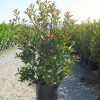
At Premier Nursery, we offer a wide selection of shade, ornamental, evergreen, fruit, and flowering trees in various sizes and stages of maturity, including many larger trees not offered by other nurseries. Our trees are Texas-native, climate-adapted species that thrive in the local North Texas climate. Our staff has the expertise and guidance to help with species selection, planting tips, and care advice. Discover how our expertise elevates your outdoor spaces—courteous service, every time. Contact us at 817-540-4580 or complete the form below.
Tree Delivery and Planting
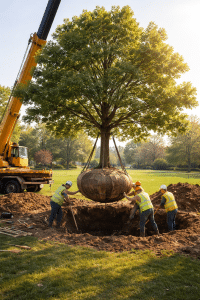 Premier-Nursery delivers and plants healthy trees for homes, businesses, and public spaces with care and expertise. We simplify the process from selection to soil preparation to aftercare, so your new trees establish quickly and thrive. Whether you’re adding shade, replacing a landscape, or creating a stunning focal point, our team handles delivery and planting with precision and reliability.
Delivery and Planting Services We Offer
- Broad selection of trees, including native varieties and ornamentals, in sizes from 5-gallon to 100-gallon and larger upon request.
- Reliable delivery on a schedule that fits your project timeline, with careful handling to protect roots and trunks.
- On-site professional planting by experts who assess site conditions, spacing, and root-ball integrity.
- Soil preparation and root-ball care, including amendments when needed, proper backfill, and efficient irrigation planning.
- Mulch, staking, and initial irrigation solutions to support establishment and growth.
- Aftercare guidance and optional maintenance plans to keep trees thriving after installation.
- Services for residential landscapes, commercial properties, school campuses, and municipal projects.
Click for more information
How Tree Delivery and Planting Services Work
- Choose your trees: Browse our catalog or consult with our plant specialists to select species and sizes suited to your climate and site.
- Schedule delivery and planting: We coordinate a convenient date and time, then bring trees in ready-to-plant condition.
- On-site planting: Our installers perform proper digging, root protection, staking if needed, and initial watering and mulch application.
- Aftercare support: You receive care instructions, and we offer maintenance options to ensure healthy establishment.
Frequently asked questions about Tree Delivery and Planting
Do you deliver to my area? We service the DFW area and can confirm availability for your location during checkout or by contacting our team.
What sizes are available? Our trees range from 5-gallon to 25-gallon containers, with larger specimens available for select species.
Will you plant trees for me? Yes. Our experts handle all planting work on-site.
What regions do you serve? We serve residential, commercial, and public projects within our DFW service area; please inquire for specifics.
What does the tree planting service include? It includes site assessment, proper digging, root-ball handling, backfill, mulch, staking if needed, and initial watering.
How much does delivery and planting cost? Pricing varies by tree size, quantity, and location; we provide a clear quote after a short consultation.
What maintenance is required after planting? Frequent initial watering, mulch management, and follow-up care guidance; we can tailor a maintenance plan to your site.
Ready to transform your landscape with trees that endure? Contact Premier-Nursery today at 817-540-4580 or complete the form below to start your delivery and planting project.
Tree Pruning and Trimming
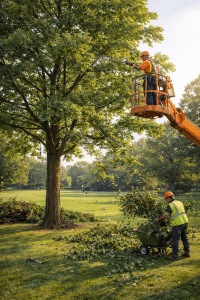
Pruning is the careful art of removing specific branches to improve a tree’s health, structure, and appearance. Premier Nursery’s tree pruning service helps prevent disease, reduces the risk of storm damage, and encourages stronger growth, better fruiting, and a balanced canopy. It’s about guiding a tree’s growth so it lives longer and looks its best. Contact Premier Nursery’s tree experts at 817-540-4580 or complete the form below for additional information on trimming your trees.
Click for more information
Frequently asked questions about Tree Pruning and Trimming
 When is the best time to prune trees? Pruning timing depends on the species and your goals. In general, many trees are best pruned in winter while dormant, which reduces stress and helps shape new growth in spring. Flowering trees may be pruned after they finish blooming. Avoid heavy pruning in late summer or fall, which can stimulate new growth that won’t harden before winter.
How much should be pruned at one time? Avoid removing more than about 20–25% of a tree’s canopy in a single pruning session. Removing too much at once can stress the tree and leave it vulnerable to disease or sunscald. For mature trees, it’s often wiser to space pruning over several years.
Can pruning harm a tree? Yes, improper cuts can harm a tree. Bad cuts can create weak points, invite disease, or cause poor healing. Remove dead or diseased wood first, use clean sharp tools, and make proper cuts just outside the branch collar. When in doubt, consult a tree expert.
What tools will be needed? Basic tools include hand pruners, loppers, a pruning saw, gloves, and eye protection. For larger branches, you may need a pole saw or professional equipment. Sterilize tools between trees to prevent disease transmission.
How can you tell if a tree needs pruning? Look for dead, damaged, or diseased wood, branches that rub or cross, cracked branches, or branches growing toward the center of the tree. Also, sparse or unbalanced growth can indicate a need for thinning or shaping pruning.
What’s the difference between pruning for health, safety, and aesthetics? Healthy pruning focuses on removing diseased or damaged wood to improve structure and vigor. Safe pruning removes hazards like hanging or overhanging limbs to protect people and property. Aesthetic pruning shapes the tree for appearance, balance, and size, often improving light penetration and air flow.
Should you prune fruit trees differently? Fruit trees benefit from timing and techniques that promote fruit production while maintaining structure. Training systems (like central leader or vase) help form strong branches. Light thinning to improve sun exposure and air movement often takes precedence over heavy pruning.
How often should mature trees be pruned? Most mature trees require maintenance pruning every 3–5 years, depending on species and growth rate. Younger trees may need more frequent shaping in their first 5–7 years.
Are there signs pruning can help with disease or pests?
Pruning out infected or infested wood can help slow the spread of diseases and pests. However, this is best done with proper identification and technique, so consider a professional evaluation if you’re unsure.
Our tree experts at Premier Nursery are ready to assess your trees, recommend the right pruning plan, and carry out safe, precise work. Contact us for a free consultation or book online today to keep your trees healthy, safe, and beautiful.
Tree Removal and Stump Grinding
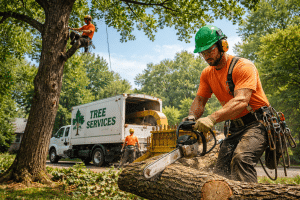 Need reliable tree removal and stump grinding? Our experts serve homeowners with safe, hassle-free service from start to finish. We remove hazardous trees quickly, using proven techniques that protect your property and landscape. After removal, our stump grinding team eliminates unsightly stumps, leaving a smooth, ready-to-use space. We handle permit guidance, debris cleanup, and responsible disposal, so you don’t lift a finger. With transparent pricing, flexible scheduling, and insured professionals, you can trust us to protect your home and yard. Free on-site quotes. Call today to reclaim safety, curb appeal, and peace of mind. Your yard, finally safe again.
Click for more information
Frequently asked questions about Tree Removal and Stump Grinding
What is included in tree removal? – Tree removal typically includes cutting down the tree, removing branches and trunk, and hauling away debris. Stump grinding or removal can be added to remove the remaining stump. Ask for a detailed scope of work so you know what’s included.
How do I know if a tree needs to be removed? – Look for signs like dead or dying limbs, major structural damage, disease, leaning trees, or trees growing too close to structures or utilities. If the tree presents a safety risk or could cause damage during storms, removal may be the best option.
What’s the difference between tree removal and stump grinding? – Tree removal takes the entire tree down, including the trunk and roots in most cases. Stump grinding only removes the visible stump by grinding it below ground level, leaving roots and soil to be reconfigured around the site.
Do I need a permit to remove a tree? – Permit requirements vary by location and by whether the tree is on a protected species or near utilities, sidewalks, or public property. Our team can confirm local permitting needs before work begins.
What factors affect the cost? – Pricing depends on tree size, location, accessibility, proximity to structures or utilities, the need for stump grinding, debris disposal, and any required permits. We provide transparent, itemized estimates.
How long does tree removal or stump grinding take? – Small, accessible trees may take a few hours; larger or more complex jobs can require a full day. Stump grinding duration depends on the number and size of stumps.
Is stump grinding safe? – When performed by trained professionals with proper equipment and safety measures, stump grinding is safe. It does require awareness of underground utilities and nearby structures.
What about cleanup after the job? – Most reputable providers offer debris removal and site cleanup, with options for mulch production from the chipped material. Confirm cleanup details in your estimate.
Will removal affect nearby plants, lawn, or hardscape? – A professional crew plans around landscaping and structures to protect beds, driveways, and foundations. Root and soil disruption should be considered in the pre-work evaluation.
If you have a specific site or needs, contact us for a free, no-obligation estimate, and we’ll tailor a plan for safe, efficient tree removal or stump grinding.”
Tree Pest and Disease Management
At our tree service company, we safeguard your landscape with proactive Pest and Disease Management. Our experts inspect, diagnose, and treat infestations before they threaten your trees. We monitor for warning signs of common pests—borers, aphids, scale—and deadly diseases such as root rot, canker, and fungal infections. Using integrated pest management, we combine careful pruning, targeted applications, soil-health improvements, and resistant varieties to minimize chemical use while maximizing results. From early detection to long-term prevention, we tailor a plan to your trees’ species, age, and site conditions. Protect your investment, boost growth, and preserve curb appeal. Schedule a free assessment today and safeguard your greenspace with trusted experts.
Click for more information
Frequently Asked Questions about Tree Pest and Disease Management
How can I identify if my tree has a pest or disease? – Start with careful observation. Look for yellowing or wilting leaves, abnormal leaf spots, holes or chewed edges, sticky honeydew, sawdust-like frass, bark cracks, oozing, cankers, or unusual growths. Note the tree species, location on the tree, and the time of year. Take clear photos and compare them with extension service guides that can help with identification.
What’s the difference between pests and diseases? – Pests are living organisms that damage trees by feeding or feeding-related actions (insects, mites, nematodes). Diseases are caused by pathogens such as fungi, bacteria, or viruses that disrupt the tree’s health. Symptoms often overlap, so correct identification is important for effective treatment.
When should I treat a tree for pests or diseases? – Early detection improves outcomes. Treat only after you’ve identified the problem and confirmed the cause. Some issues don’t require treatment if the tree can recover on its own, while others may necessitate action to prevent spread or further damage.
What treatments are available, and how should I choose them? – Treatments range from mechanical removal (pruning infested parts) and cultural practices (watering, mulching, pruning for airflow) to chemical options (pesticides, fungicides, or systemic treatments). Always use products labeled for your tree species and the specific pest or disease, and follow label instructions. Integrated Pest Management (IPM) emphasizes combining non-chemical methods with targeted, judicious chemical use when necessary.
Are organic or natural options effective? – Many organic options can help, such as horticultural oils, insecticidal soaps, beneficial nematodes, and some naturally derived fungicides. Effectiveness depends on the pest, disease, and timing. Always verify suitability for your tree and adhere to any labeling requirements.
How can I prevent pest and disease problems in the future? – Maintain tree health with proper watering, mulching, and fertilization; plant species appropriate for the site; ensure adequate spacing for air flow; prune to remove dead or diseased wood; remove and dispose of infested material promptly; monitor regularly and address issues early
Do I need a licensed professional? – For large trees, severe infestations, or diseases with the potential to spread, it’s wise to consult an expert or pesticide applicator. They can provide an accurate diagnosis, risk assessment, and a safe, effective treatment plan.
What signs indicate I should seek urgent help? – Rapid dieback, large open wounds, oozing sap, foul odors, or sudden collapse of branches are warning signs. If you see these, contact a professional promptly to assess risk and prevent further damage.
For expert, on-site guidance, contact our team to schedule a consult.
Schedule an Appointment
CALL 817-540-4580 or EMAIL info@premier-nursery.com